monocon #6
Time for the next monocon!
monocon, monochrom's unconference at UZlab!
Fri, July 4 to Sun, July 6, 2025.
No admission, but much passion.
Plug & Play!
Presented by monochrom March 6-9, 2025, at Semperdepot, Vienna. Humans, replicants, and all sentient (or semi-sentient) beings - assemble! The longest-running event at the intersection of sex and technology returns with Arse Elektronika 2025 in Vienna. This year´s theme, Plug & Play, invites you to explore the ever-evolving relationship between sexuality and technology in the most provocative, critical, and entertaining ways possible. For centuries, technological innovation has reshaped our desires, our connections, and our definitions of intimacy. From prehistoric cave graffiti to the latest in AI-driven companionship, humans have always used tools to explore and expand sexuality. But in a time of rising techno-panic, where moral outrage is quick to brand technology as an isolating force, Arse Elektronika reminds us that tech can also be a tool of liberation. From resisting mainstream narratives to amplifying underrepresented desires, sextech continues to challenge power structures and redefine human connection. Join us for a four-day celebration of the provocative, the playful, and the revolutionary. Expect an electrifying mix of talks, performances, art installations, workshops, and, of course, sleazy and subversive machines that push the boundaries of sexuality and technology. This year´s event will feature a diverse lineup of lecturers, tinkerers, and artists, including Maya Magnat, Laura A. Dima, Christian Heller, Kathleen Cherrington, Philipp Blab, Ann Antidote, Kollektiv14, Kero Fichter, Sofia Talanti, Offerus Ablinger, Rasos & Chagai, Georg Zev Mir, June Kitho, Nerea González, CornPop Bright, Felix Helmut Wagner, Stefan Lutschinger, Eva Pascoe / Cybersalon, and many more. Together, they will explore the latest developments in erotic robotics, algorithmic pleasure, artificial intimacy, and beyond. Whether you're curious about the ethics of sexbots, cybernetic kink, the political implications of teledildonics, or the uncanny intersections of biology and technology, Arse Elektronika 2025 is your playground. What to Expect:
- Lectures and panels diving deep into sextech, AI, and intimacy.
- Performances that blur the lines between human and machine desire.
- Art and installations that redefine erotic aesthetics in a digital age.
- Hands-on workshops where you can tinker with sextech and learn from leading creators.






Call for Submissions: Arse Elektronika 2025 in Vienna
PLUG & PLAY!
Humans, replicants, and all sentient (or semi-sentient) beings, gather round! Arse Elektronika, the longest-running event at the intersection of sex and technology, is back! For our 2025 edition in Vienna, we invite you to bring your sharpest thoughts, wildest performances, most provocative art pieces, and--of course--your sleaziest machines.
Technology and sexuality have always been intimately linked--just ask the folks who doodled genitalia on cave walls thousands of years ago, dreaming of the future of teledildonics. While it’s impossible to predict what’s next, one thing is certain: sex will continue to drive technological innovation, and technology will continue to reshape what we think of as human sexuality. After all, we’re not just sexual beings--we're also tool-using beings, and who says those two categories can’t overlap in some really fun, weird, and revolutionary ways?
Despite the ongoing techno-panic that technology isolates us and ruins our ability to really connect, Arse Elektronika is here to remind you that tech can be a force for liberation. Technology can (and should!) challenge the oppressive, male-dominated power structures baked into mainstream pornography and beyond, giving new opportunities for self-expression and the fulfillment of underrepresented desires. So, this is your chance to explore how technology can reshape sexuality, challenge social norms, and maybe even enhance some ahem evolutionary shortcomings.
From a critical perspective, we encourage proposals that dig deep into how technology, artificial intelligence, and artificial intimacy might help us rethink the old models of sexual connection. How might sextech be a tool of resistance? How can it become a playground for underrepresented desires? What are the consequences when tech and sex collide, creating something more than the sum of their parts?
We’re looking for contributions that provoke, challenge, and entertain. Whether you’re unpacking the politics of algorithmic pleasure, building the latest in erotic robots, or crafting a performance piece that leaves us questioning the very nature of desire, we want you. And while evolutionary biology might say that sexuality is irrational or impractical (have you seen peacocks?), Arse Elektronika is here to explore the full range of possibilities that sextech offers, from the intellectual to the downright sensual.
In keeping with tradition, we are accepting proposals for talks, workshops, performances, artworks, installations, films and tech demos. Want to tell us how sexbots will dismantle the patriarchy? Great! Have a performance that involves cybernetic pleasure loops? Fantastic! Got a new machine that rethinks what “self-expression” really means? Even better! Submissions should reflect a critical engagement with how sexuality and technology intersect, and how both can potentially free us from the limiting social barriers imposed on human intimacy. Or, at the very least, create some really interesting awkwardness at family dinners.
Please submit a 200-word abstract outlining your proposed talk, workshop, art, performance, installation, or machine demo. If you’re submitting a performance, artwork or installation, include pictures and your technical needs and a short bio (we need to know what makes you tick). Tech demos should be accompanied by descriptions, photos, or videos (we love a good demo).
Submissions are due by January 15, 2025, and selected participants will be notified by February 10, 2025. Send your brilliant ideas to arse2025@monochrom.at.
Join us March 6-9, 2025 at Semperdepot (EG Nord, Prospekthof & Mehrzwecksaal), Academy of Fine Arts Vienna, as we collectively rewire the future of sexuality and technology. We promise, it’ll be a stimulating experience.
monocon #5
Culture & Nature. Time to bring it together!
monocon, monochrom's unconference at Verein Symposion Lindabrunn!
A cooperation with Landschaftspflegeverein Thermenlinie and Gemeinde Enzesfeld-Lindabrunn.
Fri, June 21 to Sat, June 22, 2024.
No admission, but much passion.
roboexotica #25!
Do you remember the good old days of Roboexotica, when thousands of enthusiastic visitors celebrated the cocktail culture? Well, let's go back to where it happened: Grundsteingasse in Ottakring, right next to the Gürtel in Wien. We will turn Kunsttankstelle Ottakring into a robotic Cocktailtankstelle! Easily reachable by subway and tram, or even by a nice walk from the inner city. Why, you ask? Because Roboexotica will celebrate it's 25th anniversary! more: www.roboexotica.at
Arse Elektronika 2023 Linz – schedule and tickets
In less than two weeks Arse Elektronika 2023 is going to happen! The preparations are going full steam to offer all our visitors an exhilarating and inspiring event!
First, we want to share the final program.
Tickets
We are offering a 3-day festival pass, of which we have a cheaper early bird pass until September 3rd.
We will also have day tickets for the conference program on Friday and Saturday and evening tickets for all three days.
Tickets will be offered at the entrance and at https://kupfticket.com/events/arse-elektronika-festival.
Registrations for the workshops will happen through the online ticketing system.
Please note: Arse Elektronika and ars electronica are two different events, taking place at two different venues in Linz. The substancial similarity of the names is purely historical. Arse was held in the USA almost for decades now, ars is big in Europe... Now both take place at the same time in the same city, which might be confusing. Although we have an agreement for mutual advertising, our tickets will not entitle you to enter any venues besides DH5. In return we will not accept ars electronica tickets for DH5.
Location
All of Arse Elektronika will happen at
DH5, Herrenstraße 5, 4020 Linz.
We will have the conference program in the Salon where talks and workshops will happen as well as workshops in the Kitchen and the Terrace. In the Courtyard we will have our concert stage. All the other parts of DH5 will house the Arse Elektronika exhibition.
Travel
For those who travel to Linz by train, we recommend getting a seat reservation. The trains might get very crowded due to the Ars Electronica festival.
Once you arrive in Linz you can either take a 20-minute walk to DH5 or take a tram 1, 2, 3, or 4 from Linz Hauptbahnhof towards Universität or Landgutstraße and hop off at Taubenmarkt. Tram tickets can be purchased at the tram stop or through the online app Wegfinder.
ye olde self-exploitaition: monochrom turns 30!
 It's been thirty years... Time for a brobdingnagian extravaganza featuring old and new content!
So: come! All of you! I a manic style and dressed up, if possible!
A cooperation with Volkshochschulen Wien. Bam, Oida!
It's been thirty years... Time for a brobdingnagian extravaganza featuring old and new content!
So: come! All of you! I a manic style and dressed up, if possible!
A cooperation with Volkshochschulen Wien. Bam, Oida!
Thu, June 29, 2023. Doors open at 19:00, the gala is starting at 19:30.
Volkshochschule Wien-Rudolfsheim, Schwendergasse 41, 1150 Wien, Großer Saal.
No admission, but donations will not be rejected.
Arse Elektronika 2023: Sexponential
Arse Elektronika is back! And it is our 10th iteration!
September 7-9, 2023 at DH5 in Linz, Austria
Humans, replicants!
Technology and sexuality have always been closely connected, from ancient cave drawings of genitalia to modern virtual-reality pornography. While it is impossible to predict the future, the history of technology suggests that sex will continue to be a driving force in technological development and that technology will shape human sexuality. Despite the common belief that technology isolates us and destroys genuine human connection, it is essential to remember that humans are both sexual beings and tool users. Technology can be used to challenge and change the oppressive and male-dominated power structures within expressions of sexuality, e.g. mainstream pornography. It can also provide new opportunities for self-expression and fulfillment of underrepresented desires.
From an evolutionary perspective, sexuality is a complex and central aspect of the human experience that is not always rational or practical. Some behaviors and characteristics that result from sexual selection in animals may have negative consequences or be detrimental to an individual’s survival or the survival of a population. However, homo sapiens has created a cultural environment that allows for exploring sexuality beyond the narrow purpose of reproduction. While evolution has already shaped humans to be highly sexual beings, society has imposed additional limitations and constraints on sexuality, often in the form of social barriers.
Sex technology offers a range of possibilities for communication and resistance, including teledildonics, sex machines, biohacking, and the creation of bodies with enhanced sexual capabilities. These ideas have long been explored in science fiction and literature, and it is time to consider them both intellectually and sensually. Technology, artificial intelligence, and artificial intimacy can help us to think and understand sexuality within the context of social evolution and potentially break free from these limitations.
Come and enjoy talks, performances, games, workshops, several machines, a system!
As part of the festival, „edition mono“ will publish the Arse Elektronika Anthology #5. We encourage literary submissions to accompany your festival entry.
Hedonistika 2022
This year the Ars Electronica Festival asks:
„So can we change not only the world we live in, but also ourselves?“
Before we set out to answer this question, we want to explore the fundamental human driving force: Pleasure. To this end, Hedonistika offers a playground to inspect and reflect upon our deep desire to enjoy our time on this planet. With the help of the great enabler and alleged savior Technology, we will question the technocratic promise.
A group of technophilic artists will present interactive machines and immersive experiences to elevate our pleasure, alleviate our suffering or scrutinize our peculiar desires.
Through the dark of the nights, we will celebrate our virtues and vices with robotic servants of pleasure and a human nightline to keep us dancing in the right direction.
Thursday, Sept 8 to Saturday, Sept 11, 2022 @ DH5, Herrengasse 5, Linz / Austria.
Details can be found here.

roboexotica twice: this is CULT @ Fantastic Fest
This year monochrom will present the one and only festival for cocktail robotics ROBOEXOTICA twice:
The cooperation with Alamo Drafthouse and Fantastic Fest 2022 has just been announced. Expect not only a wine spritzer from Spritzerbot, a nicely grilled sausage from Old Sparky (Texas Sausage Massacre) or win a drink from Prostate Hero (think Dance Dance Revolution, but with a butthole). We also will see some robots from our long-term American roboexotica veterants.
Fantastic fest runs September 22nd - 29th in Austin, TX. Badge sales already started, so hurry up! (And if you are not able to attend Fantastic Fest in the United States, you still can count on the regular roboexotica extravaganza in Vienna. Save the date: Dec 1st - 4th at Freiraum, Museumsquartier Wien, Vienna, Austria. Twice the fun!)
 link
Sponsorship Candidates: https://www.newsbtc.com/news/company/heres-a-list-of-trusted-non-gamstop-casinos-in-the-uk/
link
Sponsorship Candidates: https://www.newsbtc.com/news/company/heres-a-list-of-trusted-non-gamstop-casinos-in-the-uk/
Mad as Hell: Is There an End to Subversion?
A New HOPE (2022) hosts a talk by Johannes Grenzfurthner. We (almost) made it through a pandemic abyss, the Trumpian "fake news" wars, right wing QAnon trollery, and pathos-laden political truthiness. As a provocateur, political artist, and activist, Johannes asks the simple question: What is there still to be done? How can there be subversion in a world that is hellbound on waging war with rationality? Is there still a potential in radical pranks and stunts in a mediaspace that is built on spectacle? What can really be done if you are (to quote a 1970s classic) mad as hell, and you are not going to take this anymore? Saturday, Jul 23, 2022, 17:00, at St. John's University in Queens, New York City.
Masking Threshold: Best Editing at ‘Unnamed Footage Festival’
Unnamed Footage Festival awarded Masking Threshold Best Editing of the Festival!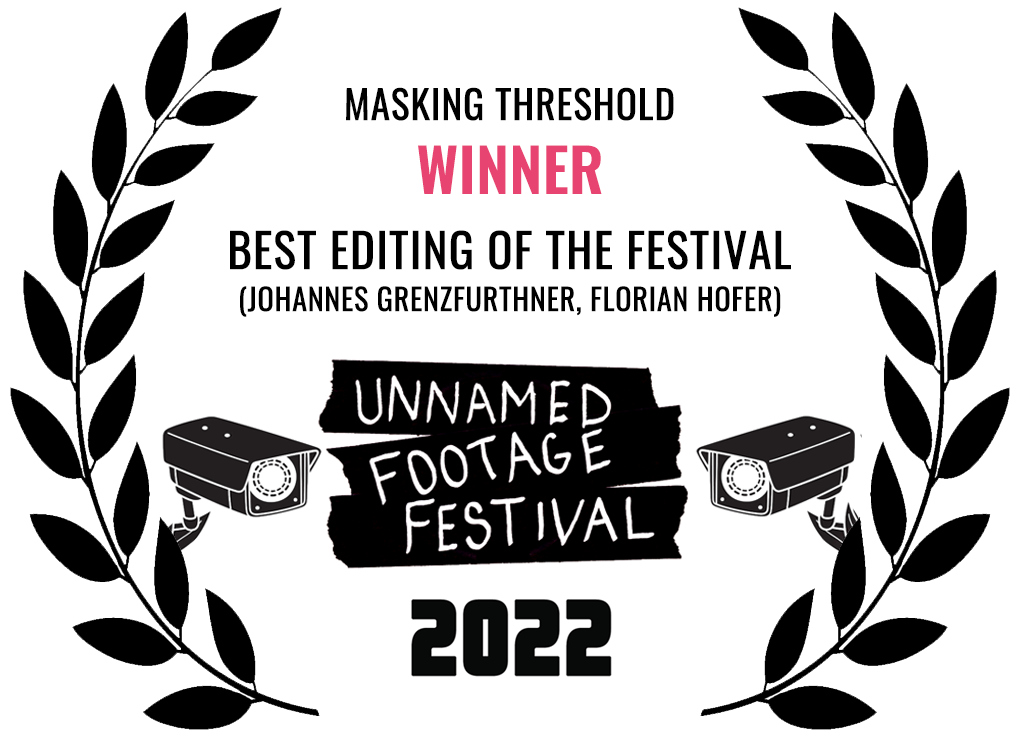
Cinema Austriaco reviews Masking Threshold
Marina Pavido reviewed Masking Threshold for Cinema Austriaco.
Masking Threshold è il film che non ci si aspetta. Un film dalla forma ibrida, che in seguito a un iniziale approccio documentaristico assume pian piano le connotazioni di un horror in un crescendo di tensione e comicità. Johannes Grenzfurthner ha attinto a piene mani dai moderni linguaggi dei social media e, nello specifico, da Youtube. Il suo Masking Threshold diviene, così, al contempo, una profonda, semiseria riflessione sul mondo in cui viviamo e sulla società.Link (Italian)
Link (German)
FM4 reviews Masking Threshold
Review of Masking Threshold in FM4.
Horrorfilm, Video-Tagebuch, Psychogramm des Wahnsinns – Johannes Grenzfurthners neuer Film ist vieles, aber sicher nichts für Zartbesaitete. Im Zentrum steht ein IT-Nerd, der an einem Tinnitus leidet und sich im selbstgebauten Labor davon heilen will. Ein krudes Experiment jagt das nächste - was folgt, sind der komplette moralische Verfall und eine geballte Ladung Wahnsinn: Der Nerd wird zum Mörder.Link
Kleine Zeitung reviews Masking Threshold
Review of Masking Threshold in Kleine Zeitung.
"Was immer das ist, es ist kein Tinnitus." Geplagt macht sich ein IT-Techniker daran, dem Ursprung der Geräusche in seinem Kopf auf den Grund zu gehen. Die harmlosen Tests seines Gehörs münden in eine blutrünstige Obsession. Regisseur Johannes Grenzfurthner inszeniert diesen Horror-Trip ins Selbst mit einer Makrolinse. Die Ekeleffekte haben so größtmögliche Präzision und Detail. Die rasante Schnittabfolge reiht sich ein in die Sprache der Aufmerksamkeitskultur und Online-Parallelwelten. "Masking Threshold" ist provokant, spielt mit Verschwörungselementen – und provoziert sein Publikum.Link
The Gap interview about Masking Threshold
Manuel Fronhofer of Austrian magazine The Gap interviewed Johannes Grenzfurthner about Masking Threshold!
Johannes Grenzfurthner, Mitbegründer des Kunst- und Theoriekollektivs Monochrom, wurde zuletzt für »Masking Threshold« international auf diversen Genrefilm-Festivals gefeiert. Sein Protagonist macht sich darin wortreich und in immer unbarmherzigeren Experimenten auf die Suche nach einer Erklärung für den Tinnitus, der ihn – im wahrsten Sinne des Wortes – in den Wahnsinn treibt. Der wirklich außergewöhnliche Horrorfilm feiert bei der Diagonale seine Österreichpremiere.Link
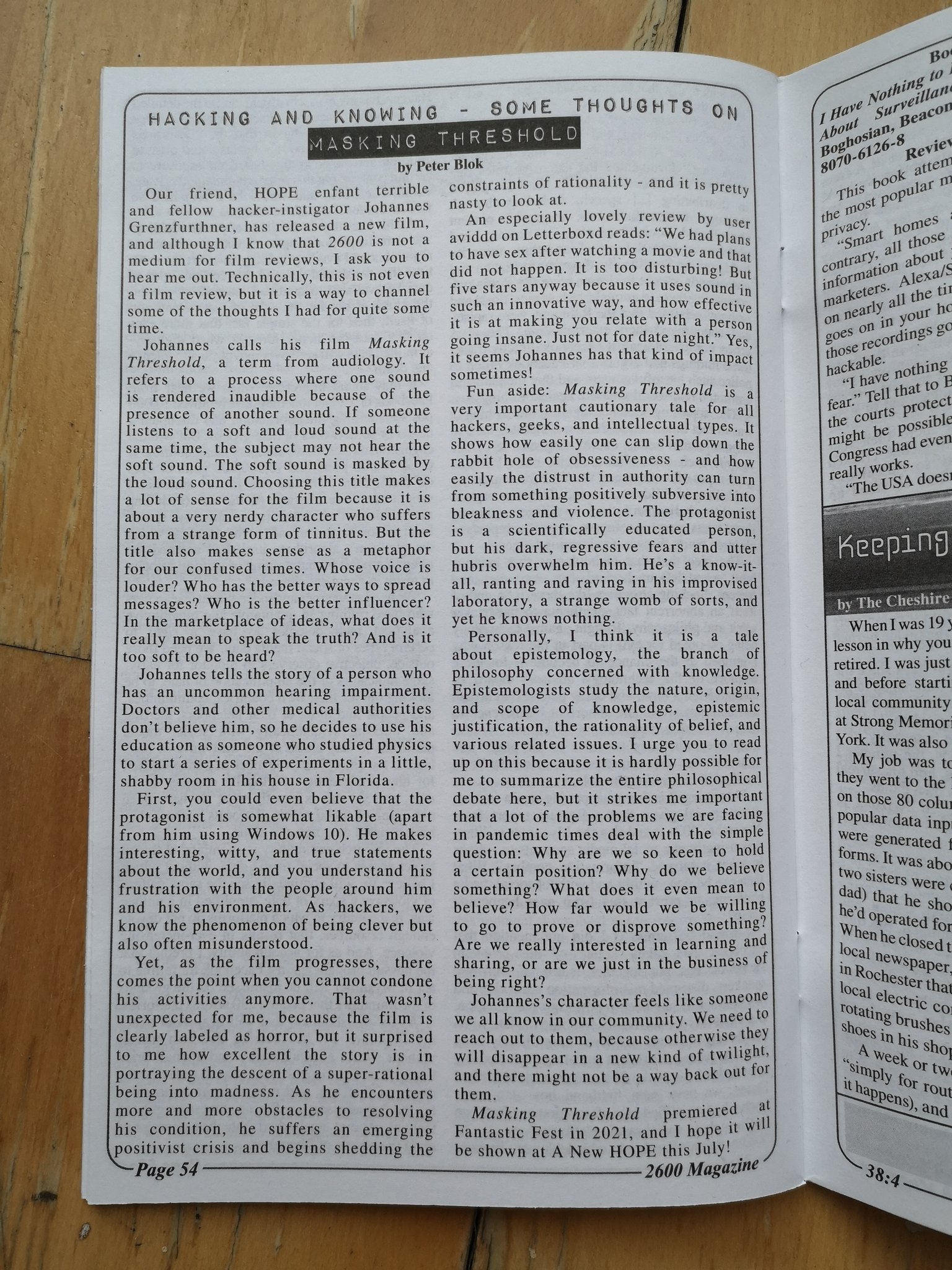
2600 reviews Masking Threshold
The Farsighted reviews Masking Threshold
thepaintedman published a wonderful review of Masking Threshold!
Johannes Grenzfurthner’s Masking Threshold is one of the least pleasant viewing experiences I’ve had in a long time. Don’t mistake this for me saying that it’s a bad film, though… it’s inventive, unique, and clever. It’s a truly singular vision. But that vision is not an easy one to endure. In fact, this found footage fanatic would argue that it’s probably one of the best example of the POV filmmaking methodology I’ve ever seen, a film that is truly inseparable from the filmmaking style and couldn’t be done any other way without losing serious effectiveness.Link
Grimoire of Horror reviews Masking Threshold
Adam Symchuk published a great review (4.5/5!) of Masking Threshold!
It is pretty uncommon to come across a unique feature in cinema, not to say there is a lack of original ideas, but a fully new concept and approach is a rarity in the age of mass media. Masking Threshold marks itself as one of the most unique and ambitious found footage films ever crafted, an impressive feat in a genre already pushing the bounds of ingenuity and finding new ways to terrorize its audience.Link
The Hollywood Reporter: Masking Threshold will be released by Drafthouse Films
Giant Pictures releases movies and series across major streaming platforms like Apple TV, Netflix, Tubi, The Roku Channel, Pluto TV, IMDb TV and Peacock. Drafthouse Films’ first two acquisitions are NR. 10, directed by Alex van Warmerdam (‘Borgman’), and Masking Threshold, a psychological horror pic from director Johannes Grenzfurthner.Link
Both genre pics bowed at Fantastic Fest and will be released this spring in Alamo Drafthouse theaters. NR. 10 and Masking Threshold will then become available across Giant Pictures’ streaming platforms and via the Alamo On Demand platform.


 .
.






 (2006-2011)












 .
.